Alright guys. I gave Blogger a good chance. But, it just got too confusing. So, as of April 2nd 2014, I'm moving my school blog to WordPress. Everything is moving.
So, I hope to see you guys at my WordPress blog. I won't be deleting this one until everything is moved.
Regards,
SadieAnn
Wednesday, April 2, 2014

Tuesday, April 1, 2014
2013-2014 English Semester Report
English
In
this first semester of the Ron Paul Curriculum,
I've learned more about literature and what goes into it. I have
learned about genres, the many forms of literature, and the five
parts of fiction. Also over this first semester, I have read some
really good books by great authors. In this semester report, I will
cover what I have learned. I hope you enjoy this essay!
Five
Parts of Literature:
The
first thing I learned in English was the steps that go into writing a
fiction story. Every story has five parts. These parts are the
plot,
setting,
character
development,
theme,
and author's style.
So,
coming up with the plot
is the first step to writing any story. To make a good plot, there
are five more more steps to complete. There is the exposition,
rising
action,
climax,
falling
action,
and resolution.
In
any good story, the author must write a satisfying introduction to
the story called the exposition.
The exposition covers the beginning of the book and introduces the
characters of the story. This first part of the plot shows what the
main character's life is like and some of the things going on in
his/her life.
Next,
the rising
action is
the part of the story that builds up to the climax. This usually
introduces the big conflict that the characters have to face. The
rising action usually takes up most of the story and can also
introduce subplots as the story climaxes.
The
third part of the plot is the climax.
Here, the story's conflict is at its height. This climax is where
everything the story was building up to falls into place. The climax
usually takes place in one exciting scene.
Then
comes the falling
action.
This is where the author starts drawing the story to an end. The
characters solves all the conflicts that happened in the rising
action and climax.
Finally,
the resolution.
This is where the story is concluded. The characters may have won the
big conflict or
the
author could have set up the ending for another book to continue the
story.
Moving
on the next point in literature. The setting
of
the story is basically the backdrop to what happens in the book. Good
authors can help you visualize where and how things take place. The
setting is often described in the exposition, early on in the story.
There are many ways for the setting to appear in a book. One of the
ways for to have setting is juxtaposition.
The
juxtaposition
of a book is where two opposite things are put together to create a
contrasting effect. The book A
Connecticut Yankee in King Arthur's Court by
Mark Twain shows an excellent example of juxtaposition. The main
character is pulled from his modern time and stuck in the time of
King Arthur. Therefore, his actions and manner of speech are in
contrast to those of old England.
Another
setting appearance is milieu.
The milieu of the story is the social environment surrounding the
characters. For instance, in a pirate story, the milieu would be the
surrounding pirate environment.
A
third appearance of setting is tone.
In books, how you read the story is based on what the tone is. If the
book's tone has a romantic feel to it, then the the story is
probably a romance.
The
customs
of
the story is the next look in building the setting. Based on where
the characters go and how they get there, the customs of the story
change. For example, if the characters went to Russia, all the
different customs would be noticeable.
Next
up is satire.
The satire of the story is the act of pointed mocking at anything the
author thinks is ridiculous. If you discover satire in a book, the
author might be trying to get a point across.
Visualization
is
a very important bit of setting. Without details and descriptions
throughout a story, reading would be very dull indeed.
The
final appearance setting has is mood.
The mood of the story comes from the entire feel of the book. It
helps you to understand the book better.
The
third point of literature is character
development.
Throughout a story, you should be able to see the characters develop
and mature as the book goes on. The author describes details and
creates an image of what the character look like, what the
environment looks like, etc.
There
are different types of characters. The foremost main characters are
the protagonists
and the antagonists.
The protagonist is generally on the good guy side and can be a single
character or in a group. The antagonist is usually on the bad guy
side and can be a single character or in a group. Then there are the
primary
and secondary
characters. The primary characters are the main characters, the ones
that are talked about the most. The secondary characters are the ones
in the background and play more minor roles in the overall story.
Dialogue
is a huge part in characterization. How the character converses with
other people helps to keep the story entertaining. It also shows how
the character takes to different languages spoken.
Next
is rivalry.
A healthy rivalry is very good for the characters, as it allows them
to build a good sense of judgment towards situations with the people
they don't like.
The last part of character
development is the static and dynamic characters. The static
characters are the ones that don't really grow along with the story.
They don't learn from mistakes that happen. The dynamic characters,
however, do learn lessons and grow in maturity. They are often the
“heroes” of the story.
The
fourth of the five points of literature is theme.
This part of literary analysis is important to the story at large.
The theme of the story can be interpreted differently by everybody.
No two people have the same idea of the theme of the story. The them
is generally the moral of the story or what the author is trying to
say.
The
last and final part of literature is author's
style.
Every author has a different way of writing their books. The author's
style is how they write characters, describe details, write the
dialogue, etc. Author G. A. Henty writes personal historical fiction.
His books are mostly centered around his main characters. Another
author, Arthur Conan Doyle, wrote short detective stories. No two
authors have the same style.
Five
Types of Literature
The
next thing I learned in English this semester was how many different
types of literature there are. There are five major types: novels,
novellas,
short
stories,
poems,
and dramas.
The
novel
is
a long story that is written in the everyday language, prose. It's
the longest of the five literature types. The novel is a narrative of
fictional characters and events. Novels are often in the form of
sequential stories or series. A few of my favorite novels include:The
Harry
Potter
series
by J. K. Rowling, The
Lord of the Rings
series by J. R. R. Tolkien, and the Mistborn
series
by Brandon Sanderson.
Next
is the short
story.
This type of literature is also written in everyday language. A short
story isn't always “short”. It can be as long as a novel. A
short story makes use of plot, resonance, and other dynamic
components to a greater degree than an anecdote, yet to a far lesser
degree than a novel.
Some short stories include: The
Legend of Sleepy Hollow by
Washington Irving, To
Build a Fire by
Jack London, and The
Purloined Letter by
Edgar Allen Poe.
The
third type of literature is novella.
Novellas are fictional stories too. These stories usually have fewer
conflicts, unlike novels, which have more conflicts to span across a
longer story. The story of a novella is longer than a short story,
but has a far more simplified plot line than a novel. A few examples
of novellas include: A
Christmas Carol by
Charles Dickens, Call
of the Wild by
Jack London, and The
Old Man and the Sea by
Earnest Hemingway.
Next
is the poem.
Poems use a sing-song rhythm, prose and word positioning in pretty
and unique ways. Poems aren't supposed to be read as you would a
novel, as there are many forms of poems. A haiku is a three line poem
consisting of a line of five words, a line of seven words, and then a
line of five words again. An epic is a really long book poem telling
a story. An example of an epic is The
Epic of Gilgamesh.
Then there's a concrete poem which is a poem formed into a shape.
Lastly, there's just regular poems that sometimes give you a peek
into the author's life.
The
last type of literature is drama.
This is a huge part of literature. Drama is written in a dialogue
format. It is then interpreted in ballets, plays, and theater works.
Plays are performed using literature drama, such as comedy and
tragedy. The literature drama for plays is split up into scenes and
acts. William Shakespeare’s play, Hamlet,
is a form of drama.
Types
of Genres
A
genre is a term for categorizing literature, art, and entertainment.
It developed as new forms of literature became popular. There are two
major genres: fiction
and nonfiction.
Under those two genres, there are sub-genres.
Nonfiction
is
the first major genre. This genre only contains true facts and
events. Included in nonfiction is newspapers, essays, journals,
books, autobiographies and biographies. An autobiography
is
the writings of a person about his own life, making it a memoir. And
then a biography is one person's writings about another person's
life. The last type of nonfiction I'll talk about is historical
accounts.
These can be certain newspapers, documents, and eyewitness accounts.
Next
is fiction.
This is the biggest part of genres. It contains everything
that is not nonfiction. There are many sub-genres in this bigger one.
There is historical
and
realistic
fiction, science fiction and
horror, allegory, fables and
mythology, comedy, and
mystery.
First
up is historical
fiction.
This genre is literature set in an actual time period. Historical
fiction stories can contain made up characters in actual time periods
and events that happened or just revolve in the setting alone. One of
my favorite historical fiction authors is Phillipa Gregory. I've read
a lot of her good books. Realistic
fiction is
any story where the characters and events are made up, but everything
that happens could be true. It's also usually set in modern times.
It's an accurate portrayal of what the world is like now.
Science
fiction and
horror
literature
are paired together because they both use unusual creativity to
provide entertainment. Science fiction is
usually based around futuristic and high techy settings. It sometimes
takes place on far away planets,and could feature aliens.
Horror literature uses graphic
words and scenery to instill feelings of dread and sometimes fear in
both the characters and the reader. Horror is more common in movies
and TV, but there is certainly existing horror in books as well.
Next
is allegory.
This genre is a literary device in a literary and visual, or musical
form represent or symbolize ideas and concepts. Allegory literature
generally uses fictional characters and stories to present nonfiction
truths. Allegory is often used to critique culture. Fables
and parables are
short narrations demonstrating a useful truth. Fable often use human
speaking animals in legendary and supernatural tales. Myths are used
to lift up or tear down, while fables are used to make a point. My
favorite is Aesop's Fables. Mythology
literature
is legendary or traditional narratives often based in part to reveal
human behavior and natural phenomena by it's symbolism; often
pertaining to the actions of the gods. The most commonly known
mythological stories are those of the Roman and Greek gods.
Comedy
is any work or discourse generally intended to be humorous or to
amuse by inducing laughter, especially in theater, TV, film, and
standup comedy. No matter what form comedy comes in, it's purpose is
always to humor. Comedic literature can be written with
juxtapositions, jokes, or other literary devices. Satire
is
a genre in which humorous stories ridicule things such as the
government and society in order to evoke change. Jokes are told to
make the person laugh, and then think about the point that was
introduced in the joke. Satires are supposed to make you stop and
think about the meaning. Lastly, we have mystery.
This genre is fascinating because it usually follows a detective
trying to solve a case. It allows you to keep up and see if you can
figure out the case along with the character. The
Adventures of Sherlock Holmes by
Arthur Conan Doyle is one of the earliest mystery stories created.
All
in all, I've learned so much in this semester of English. It's really
helpful to be able to read a book and see what it lengths the author
went through to get the finished product. Knowing how to analyze
literature opens new doors for students who want to get into the
publishing business. Literary analysis allows you to look at a story
and know how to find the theme, sympathize with the characters, and
eventually, to write your own story.
Tuesday, March 4, 2014
Tuesday, February 18, 2014
Thursday, February 6, 2014
Willam Wallace's Fight for Freedom
Lesson
65 Essay
In
1270, a man named William Wallace was born. He was born in Scotland
and was a landowner. Not much is known about this man's early life. During
William's childhood, Scotland was ruled by Alexander III, who ruled
with stability and kindness. When he died, his granddaughter reigned
for awhile, but after her death she left no clear heir. Several great
families tried to lay claim to the throne. The Scottish government
stepped in and suggested that Edward I of England be king. However,
the people of Scotland wanted
John Balliol as their king.
Edward
pressured John to abdicate his throne and John did just that. Now
Edward was king of Scotland, as well as England. However, most of the
Scots still saw John as their true king and did not want to be
governed by England.
William
Wallace started gathering an army to fight against the English.
Wallace burned the town of Lanmark, killing the English sheriff in
the city. He was less than thirty years old when he marched his army
to defeat the strongholds on the English barrier.
Some
time after this, an English army met William's army near Stirling and
the Fourth River. Even though Wallace was outnumbered, he managed to
gain the upper hand due to his cunning strategies. The Battle of
Stirling Bridge, and subsequently Stirling Castle, were both won by
this little band of Scots.
William
Wallace was knighted and declared the guardian of the kingdom for
these incredible victories. Only four months after the battle at
Stirling, Edward himself invaded Scotland for a second time. The
Scots responded to this invasion by trying to follow the English army
and to attack them at their weaker points. This turned sour as the
Edward's army pounced on the chance to engage the Scots and turned
his army to face them. Edward defeated the Scots and was crowned king
in 1304.
Wallace
somehow escaped and lived as a refugee. Sadly, in 1305, Wallace was
betrayed by a Scottish knight who was loyal to Edward. William was
tried in Westminster Hall and convicted of treason to the crown. He
was executed in a terribly painful way and parts of his body were
displayed as warnings around Scotland.
William
Wallace didn't free Scotland from English rule during his time on
Earth, but he was seen as a martyr and hero to his people to fight
for their freedom. He kept their hope and will to fight alive, and
the Scots finally earned their freedom within 50 years after William
Wallace's death.
Wednesday, January 29, 2014
Banana and Chocolate Chip Muffins
 I got this muffin recipe from Jenna, a girl I talk to on my school curriculum. She makes these muffins for her siblings and I decided to make them for mine. My family LOVED them. So I thought, "why not show the world how to make these?" I hope you enjoy this easy, delicious recipe for breakfast, on-the-go meals, or just plain snacking! Happy baking!
For this recipe you'll need:
-1 cup butter, softened
-1 1/2 cups sugar
-4 eggs
-2 tsp. vanilla
-4 cups flour
-2 tsp. baking soda
-2 cups mashed bananas
-1 1/2 cups chocolate chips
Step One: Put the butter, sugar, and vanilla in an electric mixer. Mix on medium speed until well combined.
 |
| Step 1 |
 |
| Step 1 |
 |
| Step 2 |
 |
| Step 2 |
 |
| Step 3 |
 |
| Step 3 |
 |
| Step 4 |
 |
| Step 4 |
 |
| Step 5 |
 |
| Step 5 |
I hope you enjoy these muffins as much as my family did!
Monday, January 27, 2014
Genres
Lesson
70 Essay
A
genre is the word used to distinguish different
groups of literature. The biggest distinction in literature is made
between nonfiction and fiction. Nonfiction
literature is any work that is written about real historical people
or events and contains only facts. Fiction is all other works of
literature.
Biographies/Autobiographies:
This genre is nonfiction. Biographies are the type of nonfiction that
are written about one person in particular. Autobiographies are
similar to journals and are the memoirs of the person who is the
subject of the book. An example of an autobiography is Laura
Ingalls Wilder.
She wrote a series of books about her life.
Fantasy:
This is a fiction genre. Fantasy is the work of literature that
describes strange settings and other worldly characters. This fiction
type invites suspension of reality. Fantasy novels may have some
realistic portions, but much of the stories are imagined. Two of my
favorite series, The
Lord of the Rings by
J.R.R. Tolkien and Harry
Potter by
JK Rowling, are examples of fantasy.
Mythology:
A fiction genre as well, mythology is legend or traditional
narrative, and is often based in part on historical events. These
stories reveal human behavior and natural phenomena by its symbolism;
often these are the actions of the gods. The book Classic
Myths to Read Aloud by
William F. Russel is an example of Greek and Roman myths.
Fables/Parables:
This genre is one of my favorites. Fables are narrations
demonstrating a useful truth. These short stories often have animals
speaking as humans and are supernatural and legendary tales. A
classic example of fables is the book Aesop's
Fables.
Parables are similar to fables. One of my favorite parables is The
Parable of the Sower in
Matt. 13 of the Bible.
Monday, January 13, 2014
Things I Would Have If I Was Shipwrecked
Lesson
65 Essay
Assignment:
Choose two devices,
tools, or gadgets that you would like to have with you if you were
shipwrecked like Robinson Crusoe
If
I was shipwrecked like Robinson Crusoe, the items that I would like
to have with me would be: a leatherman
and duct
tape.
Leatherman:
I chose a leatherman because I think they are a very useful
multi-tool. With knives, scissors, screwdrivers, pliers, and files,
all in one easy to hold body, this would help greatly in survival on
an island.

Leatherman
Duct
Tape:
I chose duct tape because, well, who can go wrong with duct tape?
It's extremely durable and long lasting. Duct tape is also
waterproof, so you could construct make-shift cups and strainers for
water.

Duct Tape
Friday, January 10, 2014
The Life of Kublai Khan
Lesson
60 Essay
Even
though he was an intelligent, and skilled warrior, Kublai did not
rise to power until his thirties. Before Kublai became Khan, his
brother Möngke Khan
rule, and Kublai was put in charge of manning their territory. Kublai
helped his brother overthrow the Song dynasty and unify the Chinese
under the Mongols. Kublai came to power as the Great Khan several
years later.
As
the Khan of the Mongol Empire, Kublai was much wiser and thoughtful
in comparison to his predecessor, Genghis Khan. He ruled his subjects
fairly, and, rather than utterly destroy civilizations, he treated
them with generosity.
In
1271, Kublai Khan established the Yuan dynasty. The economy was
primarily based on agriculture, but, by building on past successes,
they were able to prosper. Many of the buildings and roads were built
or repaired.
During
Kublai Khan's reign, the Mongol empire enjoyed a time of great
prosperity. Kublai was able to represent the height of the Mongol
empire by controlling all of China. Kublai was among the first Far
East rulers to have known contact with European traders, by having
contact with Marco Polo.
Kublai
Khan lived to the age of 78. He outlived his wife and son. As he got
older, he became very overweight and suffered from many diseases. He
died in the February of 1294, after depression wore his body down.
Kublai was buried in the Mongol burial site.
Monday, January 6, 2014
The Works of Thomas Aquinas
Lesson
55
At
the age of 19, Thomas joined the Dominican monks, much to the dismay
of his parents. In fact, his parents actually kidnapped their son to
keep him away from the monks. After two years of captivity, Thomas
“escaped” from his parents and rejoined the monks.
After
some time with the monks, Thomas decided to rewrite the Christian
theology in a systematic way, using Aristotelian logic and thinking.
Aquinas's greatest
work was the Summa Theologica.
However, Thomas left the manuscript unfinished, believing that he was
called to a greater service than what he was currently working on.
Thomas Aquinas became a
priest and ordained in 1250. While he was teaching at a school in
Paris, Thomas completed his Doctorate in Theology. Most of Thomas's
time was spent in prayer, study, and writing during these years.
Some time later, Thomas
Aquinas was summoned by the Pope to attend a council. As Thomas was
on his way, a falling branch hit him and he became ill shortly after.
He was cared for by his friends, but several days later Thomas died.
Influence
of Thomas Aquinas
Thomas Aquinas's work greatly
influenced the church by using Aristotle's logic to study scripture.
Aquinas also argued that man can logically prove there is a god,
based solely on the evidence in nature. He taught new connection
between science and theology. Over time, philosophers began promoting
the idea that logic and man's senses could tell him what he needed. This was a distortion of
Aquinas's ideas. This focus on man's thinking continued into the time
of the Renaissance.
Tuesday, December 10, 2013
3 Types of Literature
Lesson 55 Essay
Novel:
A novel is the most commonly thought of types of literature. It also
happens to be the longest. It's a normally a long prose narrative
that describes
the
life of fictional character and events. Novels are often in the form
of sequential stories or series. A few examples of novels are: The
Hunt for Red October
by
Tom Clancy, The
Hitchhikers Guide to the Galaxy
by
Douglas Adams, and The
Lord of the Rings
by
J.R.R. Tolkien.
Short
Story:
The term “short story” often conjures up the thought of a set
word limit. However, there is no limit to how long a short story
should be. Like novels, short stories are written in the prose style.
A short story makes use of plot, resonance, and other dynamic
components to a greater degree than an anecdote, yet to a far lesser
degree than a novel. Some famous short stories include: The
Legend of Sleepy Hollow by
Washington Irving, To
Build a Fire by
Jack London, and The
Purloined Letter by
Edgar Allan Poe.
Novella:
Novellas, like short stories and novels, are fictional stories.
Novellas usually feature fewer conflicts, unlike novels, which have
more conflicts to span across a longer story. Novellas often focus on
just one conflict. The story of a novella is longer than a short
story, but has a far more simplified plot line than a novel. Examples
of novellas include: Call
of the Wild by
Jack London, A
Christmas Carol by
Charles Dickens, and The
Old Man and the Sea by
Earnest Hemingway.
Monday, December 2, 2013
Knighthood: The Origin of Knights
Lesson 45 Essay
–The
Feudal System hierarchy
–The
service of the king's army
The
whole idea of “warriors on horseback”, came from the Franks after
the fall of Rome and was expanded by Charlemagne. Any person who
could ride and owned armor was considered a knight in these early
times. Eventually, knighthood became a more refined position in the
Feudal system. Knights
were of the lower class nobles, and though they rode horses into
battle, they were still distinct from the cavalry.
An
important part of knighthood was chivalry.
The knights took this very seriously, even getting to the point where
they organized a code for it. Chivalry was an ethical standard that
all knights had to adhere to. When they weren't needed for battle,
knights would live in castles or large fortified houses. Knighthood
and chivalry was influenced by Christianity. Knights tried to pursue
the values of “faith,
hope, charity,
justice, strength, modesty,
and loyalty”.
Chivalric ideals were popular in medieval writing and were often
combined with romance in the Renaissance. The stories of a knight
saving a damsel in distress is still very popular in modern culture.
However,
knighthood and chivalry was forgotten during the Renaissance. Knighthood
is still granted in some societies today. Knighthood now is granted
for doing great deeds.
Friday, November 22, 2013
King Alfred the Great
Lesson
40 Essay
Alfred,
at the age of four, was anointed to be king by the Pope in Rome. This
was a strange act, seeing as Alfred had three older brother who were
eligible for the crown. But, over time, each of his brothers were
crowned as king and died shortly after. After this, Alfred became
king.
The
reign of Alfred took off on a shaky start as the Danes were invading Wessex at the time. Even though the Danes were very strong, King
Alfred eventually beat them. The Danish king, Gurthrum, was converted
to Christianity at the peace treaty that Alfred proposed. This
conversion to strengthened the ties between the two territories. In
866, Alfred the Great marched into London and reclaimed it from the
Danish control. This reclaiming of London further unified Southern
England.
When
Alfred wasn't fighting, he was busy reorganizing the military and
setting up a fleet of longships, similar to the ships the Vikings
used. Alfred also spent a lot of his life working on better education
for his people. His greatest achievement as king was reviving
education as a crucial part of English culture. He sought to have
every young man in the country educated, regardless of their station.
Throughout
his life, Alfred dealt with much sickness, and he died in the year
899. His son, Edward, succeeded him on the throne.
Wednesday, November 13, 2013
The Theme of Treasure Island
Lesson 35 Essay
The
book Treasure
Island is
a great story. There's pirates, parrots, treasure maps with black Xs.
And, a theme.
I
think the theme of Treasure Island is: Be
wary of the company you keep.
In the book, Jim Hawkins finds himself amidst some very bad people
who try to kill him.
Also,
another theme I think could fit in the story is: Money.
Those bad people that Jim is traveling with are seeking the great
amount of treasure marked on the map. They go so far as to kill most
of the crew, just to get what they want.
Tuesday, November 12, 2013
Canute the Great
Lesson 35 Essay
Canute's
older brother, Harald, was the crown prince and became king of
Denmark in 1014. Knowing that he wouldn't become king for a while,
Canute set out for England to make a name for himself. He sailed in
ships full of soldiers. Canute fought numerous battles against
England's king, Edmund Ironside, with Vikings from all over
Scandinavia. Canute eventually forced Edmund to work out a peace
treaty with him after he besieged London. This treaty stated that
Canute would become king after Edmund died, which conveniently
happened just three weeks after.
To
further strengthen his claim to the throne, Canute married Emma of
Normandy. Wary of being overthrown, he killed any Saxon who had any
claim to the throne. He named his son Harthacnut, as the the
designated heir. When Harald died, Canute moved back to Denmark to
assume kingship there. Canute was now king of England and Denmark. He
attended the coronation of Conrad II as Holy Roman Emperor in Rome.
Kings
who appeared to be on good terms with God often had happy, prosperous
reigns during this time. Canute strove to reconcile himself with the
church and his people after his harsh invasion.
When
he got back from Rome, Canute decided to conquer Norway and crown
himself king of Norway. However, he was overthrown after imposing
taxes there. Canute died in England in 1035, and was buried in
Winchester. His son continued to rule the kingdom until his own death
in 1042. The combined kingdoms, England, Denmark, and Norway, over
which Canute ruled, returned to their former rulers.
Friday, November 8, 2013
Wulf the Saxon: A Review
Lesson 30 Essay
It begins with a boy
named Wulf. He is a Saxon thane in the service of Harold. In the
first chapter, Wulf crashes into a young man named Walter Fitz-Urse.
Walter, a Norman freeman in service to the bishop, demands an
apology. Wulf gives his apology, but, when Walter doesn't accept it,
Wulf exclaims that he wished all the Normans were out of England.
Harold punishes Wulf for being rude by banishing him to his lands for
a while.
Osgod, Wulf's man,
accompanies him. Leof, Wulf's teacher, teaches Wulf about keeping his
lands and people in good condition. He is taught how to throw an axe
and to fight. Wulf grows to be a strong man and wise battle planner.
It is a year before Wulf is called back to court. Sometime after
Wulf's return, Harold is captured by Duke William and held captive.
Wulf is able to get back to England and free Harold with the help of
a friend named Guy de Burg. Wulf starts suspecting that his old
adversary, Walter Fitz-Urse is plotting to kill Harold so William
could become king instead. He sends one of Osgod's friends to watch
Walter. Wulf's suspicions come true as he sees Walter sneak up to
Harold's room at night. There is a fight and Walter dies.
Battles
continue to happen after this, and these such battles eventually lead
up to the Battle of Hastings. (This is a very important and very true
battle in history.) Off in another mini battle, Osgod loses his arm.
Wulf tells him to stop fighting and
wait until he's needed.
Harold, who is king by now, is shot with an
arrow and is killed. Wulf and Beorn are about to be killed as well
when the Lord de Burg jumps in front of them. He pleads for their
life, and in exchange William will become king. William agrees and
he is made king. Wulf, Osgod, and Beorn are
made prisoners and are put in the care of the de Burgs. Once the
Lord de Burg has them under his roof, he tells Wulf that he can marry
his daughter, Agnes. Wulf accepts the offer, and they get married and
have a son. But after this, sadly, Wulf attends the burial of Guy de Burg. Guy
had been badly injured at a previous raid on Harold's camp, and had never
recovered fully.
This
book is indeed very sad, but also has a very good look on Saxon and Norman
culture and lifestyle.
Tuesday, November 5, 2013
The Life of Charles Martel
Lesson
30 Essay
Charles
escaped from his mother and began organizing support from the nobles
of the kingdom. Charles was called to be the army's leader when a
rogue band of Franks attacked the kingdom.
However, even though
Charles led a magnificent battle, his army was outnumbered and
Charles wisely withdrew the army. This loss turned out to be the only
defeat of his military career.
Charles retaliated on his enemies later on at the Battle of Amblive.
He
won the Battle of Amblive by using three tactics that would become
his trademarks:
-Appearing
where
his enemies least expected
-Attacking
how
his enemies least expected
After
winning this battle, Charles took over government of France. He never
claimed the title of king, but instead served in the position of
mayor of the palace for the rest of his life. Charles showed mercy to
the people who imprisoned him. From the years 718 to 728, Charles had
many victories, gained the loyalty of surrounding nations, and
conquered part of Southern Germany. In 731 he began preparing to
battle the Muslims who
invaded
Iberia and conquered the Visigoths there.
The
Battle of Tours:
The Muslims had already taken Iberia, and so they invaded France. In
732, Charles staged a surprise attack on the Muslims. The Battle of
Tours lasted seven days of skirmishing, before the Muslims were
eventually beaten back by the well trained and equipped Frankish
army. It was this hammering of the Muslims and repelling them, that
gave Charles the name “Martel”, or Charles the Hammer. This
battle is credited as saving Christendom from Arab/Muslim conquest.
Although the Muslims had been previously conquering unchecked, this
defeat kept them from expanding.
Charles
Martel died in 741, leaving behind a legacy that grew in his son,
Pepin the Short and his grandson, Charlemagne.
Monday, October 28, 2013
When Hurricane Ike Hit
Lesson 25 Essay
It
was just an ordinary day in September 2008. My siblings and I were
watching a movie when we heard thunder and really loud wind. It got
dark and all of a sudden it was pouring rain. Mom said this storm was
the remnants of Hurricane Ike that came up from Texas. The winds were
going up to more than 70 miles per hour!
We
live on a farm in Ohio, and we have a silo. When we moved to this
farm, the silo had a little piece missing from the top, and when the
storm hit, the wind blew the rest of the top off. I remember that it
was dangerous to go outside because the metal pieces of the silo top
were flying around. In fact, some of the pieces actually sliced into
our pool that we had in the yard.
The
terrible winds cut out the electricity for five days straight. We
carried buckets
of the pool water to feed our animals, wash hands and dishes, and to
flush toilets. Mom made trips to town to fill gallon tanks of water
for cooking and
drinking. Dad borrowed a generator from a friend to power the
refrigerator and some lights. He also put heavy blankets around our
box freezers to keep the food from spoiling.
It
was very terrifying because of the deadly pieces of flying metal that
could've hit something less replaceable than a pool. We are very
thankful to God for keeping us safe.
Thursday, October 24, 2013
The Life and Works of Muhammad
Lesson
25 Essay
It
all started with a man named Muhammad. Muhammad was born in 570, in a
city called Mecca, just three years after the treaty between
Byzantium and Persia was signed. Mecca was located near the ancient
shrine called Ka'ba. This shrine was said to have been built by
Abraham, whom the Muslims claim as the “father of Islam”. Anyway,
Muhammad's father died shortly after his birth and his mother died by
the time he was six. Muhammad's uncle took him in and raised him. At
the age of 24 Muhammad married a wealthy widow and became a
successful merchant.
In
the year 610, at the age of 40, Muhammad had his first revelation.
These messages told him he was the prophet of a new religion and that
he needed to prophecy to the world. These first proclamations make up
the first few passages of Islam's holy book, the Qu'ran. Muhammad
started preaching to the people of Mecca and tried to convert them to
his new religion. But his family shunned him and some people tried to
assassinate him because of his strange, new message.
In
622, Muhammad moved Mecca to a city called Medina for safety and
began witnessing there. This new city welcomed Muhammad and his
religion and
soon became the first Islamic community. He became the leader of
Medina shortly after. Not long after Muhammad came to Medina, wars
broke out between the two cities. Muhammad eventually captured
Mecca, banned the idolatry, and set up Islam as the new religion
there.
Later, in 632, Muhammad led the
first Islamic pilgrimage as he walked from Medina to Mecca to visit
the Ka'ba shrine. This shrine is the holiest place in Islam and is
today located inside of a mosque in Mecca for protection. At the end
of the pilgrimage, Muhammad gave his famous farewell sermon. Muhammad
fell ill and died several months after.
By
the time of Muhammad's death, most of the Arabian Peninsula had
converted to Islam and he had united Arabia into a single Muslim
religious nation.
To
conclude this essay, Muhammad had no idea how famous he would become
and how quickly Islam would catch on. Islam is one of the fastest
growing religions to this day.
Wednesday, October 16, 2013
Burning Nails
Here I'm going to show you how create "fire" on your fingernails.
I had this idea to see how I was with delicate designs on my nails, so this is a first try.
You can try for yourself!
To create this nail art you will need the following:

What you need
-Yellow nail polish -Red nail polish
-Orange nail polish (optional)
-Clear top coat
-Very fine tip Sharpie marker
Step One: Give your nails 1 coat of yellow polish

Step 1
Step Two (optional-depends on type of polish): Give nails another coat of yellow. This color I'm using in Sheer so I put two coats on. You might not have to if your polish is thicker.

Step 2
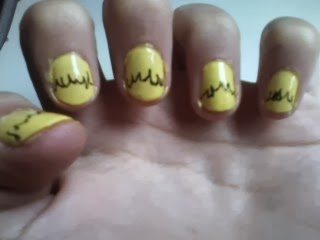
Step Three: Draw flame waves on nails with Sharpie marker

Step 3
Step Four: Paint under drawn flames with red nail polish. After this step you can splotch the orange polish on the red coat if you want. It's totally optional.


Step 4
Step Five: Use clear top coat to protect your nails

Step 5
Hope you enjoyed my tutorial and you can make your own designs in the future! :D
Subscribe to:
Posts (Atom)